> ## Documentation Index
> Fetch the complete documentation index at: https://spiceflow-docs.spicenet.io/llms.txt
> Use this file to discover all available pages before exploring further.
# React.js Integration
> This guide is for integrating the Spice Flow API with a React.js/Next.js frontend application. It covers chain authorization, delegation signing, and transaction submission with actual implementation details.
## Core Concepts
### EIP-7702 Delegation
EIP-7702 allows users to delegate transaction execution to a smart contract. This is essential for enabling cross-chain transactions without requiring users to sign multiple transactions. Read more about EIP-7702 [here](https://eip7702.io/).
### Intent
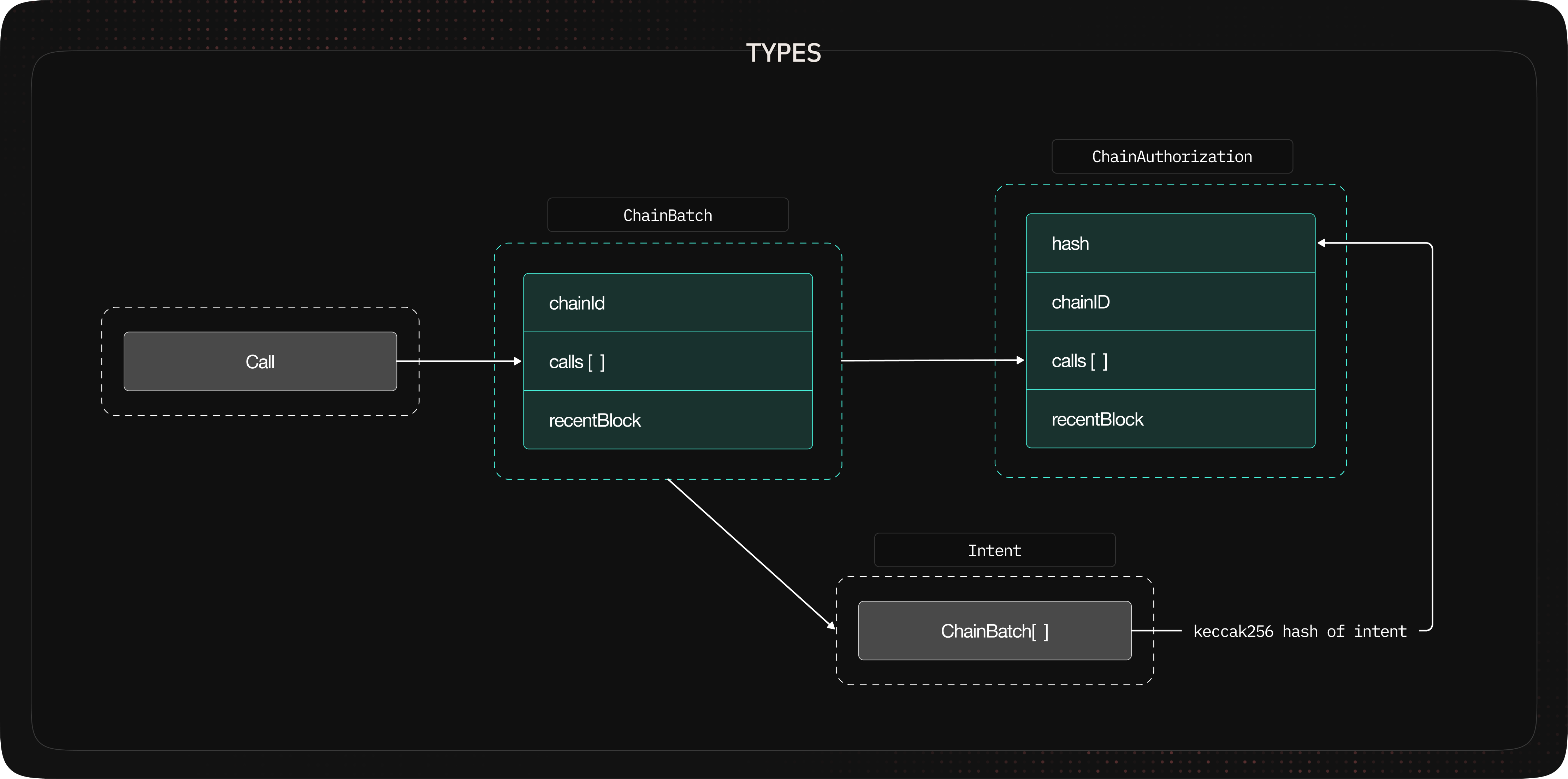
An Intent is the parent action which contains `ChainBatch`(es) wherein each `ChainBatch` is for a specific chain and has many `Call`(s).
### Chain Batch
Each chain involved in a cross-chain transaction requires its own batch with:
* Chain ID
* Call data (what to execute)
* Recent block number
### Chain Batch
A Chain Batch is the per-chain unit containing `calls` and `chainId`. Each Chain Batch is hashed (via `hashChainBatches`) to create its `hash`, which is included in the intent signature.
## Setup and Dependencies
### Required Dependencies
```json theme={null}
{
"dependencies": {
"viem": "^2.0.0",
"wagmi": "^2.0.0"
}
}
```
#### viem
Used for interacting with EVM chains. [Documentation](https://viem.sh/docs/getting-started)
#### wagmi
Used for wallet management and signing. [Documentation](https://wagmi.sh/react/getting-started)
### Core Type Definitions
```typescript theme={null}
import { Address, Hash, Hex } from "viem";
export type Call = {
to: Address;
value: bigint;
data: Hex;
};
// Input to hashChainBatches
export interface ChainBatchInput {
chainId: bigint | number;
calls: Call[];
}
// Output of hashChainBatches
export type ChainBatch = {
hash: Hash;
chainId: bigint;
calls: Call[];
};
// EIP-7702 authorization, one per chain that carries a 7702 batch
export interface Authorization {
address: string; // the delegate contract for that chain
chainId: number;
nonce: number;
r: string;
s: string;
yParity: number;
}
// POST /actions request body
export interface CreateActionRequest {
user: Address;
chainAuthorizations?: Authorization[];
intents: Array<{
mode: "7702";
signatureType: "ecdsa";
signature: Hex;
nbf: number;
exp: number;
chainBatches: Array<{
hash: Hex;
chainId: number;
tokenTransfers: unknown[];
calls: Call[];
}>;
}>;
}
```
 ## Intent Creation Implementation
This page is the low-level, roll-it-yourself path. For most apps, use the prebuilt
[components](/sdk/components) and [hooks](/sdk/hooks) (`useSpiceExecution`) instead. Even on the manual
path, do not reimplement the intent hashing: import it from `@spicenet-io/spiceflow-core`.
### Intent hashing
Import the hashing functions from the SDK rather than hand-rolling them. Two things that changed from
older examples: a chain batch is `{ chainId, calls }` (there is **no** `recentBlock`), and the intent
hash includes the `signatureType`, `nbf`, and `exp` values.
```typescript theme={null}
import { hashChainBatches, getIntentHash } from "@spicenet-io/spiceflow-core";
// hashChainBatches(batches: { chainId, calls }[]) => { hash, chainId, calls }[]
// getIntentHash(signatureType: string, nbf: bigint, exp: bigint, chainBatches) => Hash
```
### Utility Functions
```typescript theme={null}
export async function getRecentBlock(
publicClient: PublicClient,
): Promise {
try {
return await publicClient.getBlockNumber();
} catch (error) {
console.error("Error getting recent block:", error);
return BigInt(0);
}
}
export async function getAccountNonce(
address: Address,
publicClient: PublicClient,
): Promise {
try {
return await publicClient.getTransactionCount({ address });
} catch (error) {
console.error("Error getting account nonce:", error);
return 0;
}
}
```
### Creating Intent with Chain Batches
```typescript theme={null}
import { hashChainBatches } from "@spicenet-io/spiceflow-core";
function createChainBatches(
sourceChainId: number,
destinationChainId: number,
sourceCalls: Call[],
destinationCalls: Call[],
) {
// A chain batch is { chainId, calls }. No recentBlock.
return hashChainBatches([
{ chainId: sourceChainId, calls: sourceCalls },
{ chainId: destinationChainId, calls: destinationCalls },
]);
}
```
## Delegation Signing
### EIP-7702 Delegation Process
Each chain requires a separate EIP-7702 delegation signature.
Produce EIP-7702 authorizations with viem's `signAuthorization` (see the
[Native Swap guide](/guides/native-swap)), not a custom EIP-712 `signTypedData` scheme. The delegate
contract differs per chain: read it with `getDelegateContract(chainId)` from
`@spicenet-io/spiceflow-core`.
```typescript theme={null}
async function signDelegation(
walletClient: WalletClient,
address: Address,
chainId: number,
delegateContractAddress: Address,
): Promise {
const publicClient = getPublicClient({ chainId });
const nonce = await getAccountNonce(address, publicClient);
const domain = {
name: "Authorization",
version: "1",
chainId: BigInt(chainId),
verifyingContract: delegateContractAddress,
} as const;
const types = {
Authorization: [
{ name: "contractAddress", type: "address" },
{ name: "chainId", type: "uint256" },
{ name: "nonce", type: "uint256" },
],
} as const;
const message = {
contractAddress: delegateContractAddress,
chainId: BigInt(chainId),
nonce: BigInt(nonce),
} as const;
const signature = await walletClient.signTypedData({
account: address,
domain,
types,
primaryType: "Authorization",
message,
});
const authorization = {
address: address.toString(),
chainId: Number(chainId),
nonce: Number(nonce),
r: signature.slice(0, 66) as `0x${string}`,
s: `0x${signature.slice(66, 130)}` as `0x${string}`,
yParity: parseInt(signature.slice(130, 132), 16) as 0 | 1,
};
return authorization;
}
```
### Multi-Chain Delegation Example
```typescript theme={null}
import { getDelegateContract } from "@spicenet-io/spiceflow-core";
async function signMultiChainDelegations(
walletClient: WalletClient,
address: Address,
sourceChainId: number,
destinationChainId: number,
) {
// The delegate contract differs per chain. Read it from the SDK, never hardcode.
const sourceAuth = await signDelegation(
walletClient,
address,
sourceChainId,
getDelegateContract(sourceChainId),
);
const destinationAuth = await signDelegation(
walletClient,
address,
destinationChainId,
getDelegateContract(destinationChainId),
);
return [sourceAuth, destinationAuth];
}
```
## Transaction Submission
### Complete Transaction Submission
```typescript theme={null}
import { getIntentHash } from "@spicenet-io/spiceflow-core";
const RELAYER_URL = "https://tx-submission-api.spicenet.io";
async function submitCrossChainTransaction(
sourceChainId: number,
destinationChainId: number,
sourceCalls: Call[],
destinationCalls: Call[],
chainAuthorizations: Authorization[], // { r, s, yParity, address, chainId, nonce }[]
) {
// 1. Hash the chain batches
const chainBatches = createChainBatches(
sourceChainId,
destinationChainId,
sourceCalls,
destinationCalls,
);
// 2. Sign the intent hash
const nbf = 0n;
const exp = BigInt(Math.floor(Date.now() / 1000) + 3600); // 1 hour
const digest = getIntentHash("ecdsa", nbf, exp, chainBatches);
const signature = await walletClient.signMessage({
account: address,
message: { raw: digest },
});
// 3. Submit to POST /actions
const request = {
user: address,
chainAuthorizations,
intents: [
{
mode: "7702",
signatureType: "ecdsa",
signature,
nbf: Number(nbf),
exp: Number(exp),
chainBatches: chainBatches.map((b) => ({ ...b, tokenTransfers: [] })),
},
],
};
const response = await fetch(`${RELAYER_URL}/actions`, {
method: "POST",
headers: { "Content-Type": "application/json" },
body: JSON.stringify(request, (key, value) =>
typeof value === "bigint" ? value.toString() : value,
),
});
if (!response.ok) {
const errorText = await response.text();
throw new Error(`API error: ${response.status} - ${errorText}`);
}
return response; // track steps via GET /actions/{actionId}/intents/{i}/steps/{s}
}
```
See the [POST /actions](/api-reference/endpoint/actions-create) reference for the full request and
response schema.
## Best Practices
### 1. Chain Switching
```typescript theme={null}
// Always switch to the correct chain before signing delegations
async function signDelegationForChain(chainId: number, targetNetwork: Network) {
// Switch to target chain (hook from reown appkit)
await switchNetwork(targetNetwork);
// Wait for network switch to complete
await new Promise((resolve) => setTimeout(resolve, 2000));
// Sign delegation
return await signDelegation(chainId);
}
```
### 2. Progress Tracking
```typescript theme={null}
// Track transaction progress
const [progress, setProgress] = useState("");
const executeTransaction = async () => {
setProgress("Signing source chain delegation...");
const sourceAuth = await signDelegation(sourceChainId);
setProgress("Signing destination chain delegation...");
const destinationAuth = await signDelegation(destinationChainId);
setProgress("Submitting transaction...");
const result = await submitTransaction([sourceAuth, destinationAuth]);
setProgress("Transaction submitted successfully");
return result;
};
```
## Intent Creation Implementation
This page is the low-level, roll-it-yourself path. For most apps, use the prebuilt
[components](/sdk/components) and [hooks](/sdk/hooks) (`useSpiceExecution`) instead. Even on the manual
path, do not reimplement the intent hashing: import it from `@spicenet-io/spiceflow-core`.
### Intent hashing
Import the hashing functions from the SDK rather than hand-rolling them. Two things that changed from
older examples: a chain batch is `{ chainId, calls }` (there is **no** `recentBlock`), and the intent
hash includes the `signatureType`, `nbf`, and `exp` values.
```typescript theme={null}
import { hashChainBatches, getIntentHash } from "@spicenet-io/spiceflow-core";
// hashChainBatches(batches: { chainId, calls }[]) => { hash, chainId, calls }[]
// getIntentHash(signatureType: string, nbf: bigint, exp: bigint, chainBatches) => Hash
```
### Utility Functions
```typescript theme={null}
export async function getRecentBlock(
publicClient: PublicClient,
): Promise {
try {
return await publicClient.getBlockNumber();
} catch (error) {
console.error("Error getting recent block:", error);
return BigInt(0);
}
}
export async function getAccountNonce(
address: Address,
publicClient: PublicClient,
): Promise {
try {
return await publicClient.getTransactionCount({ address });
} catch (error) {
console.error("Error getting account nonce:", error);
return 0;
}
}
```
### Creating Intent with Chain Batches
```typescript theme={null}
import { hashChainBatches } from "@spicenet-io/spiceflow-core";
function createChainBatches(
sourceChainId: number,
destinationChainId: number,
sourceCalls: Call[],
destinationCalls: Call[],
) {
// A chain batch is { chainId, calls }. No recentBlock.
return hashChainBatches([
{ chainId: sourceChainId, calls: sourceCalls },
{ chainId: destinationChainId, calls: destinationCalls },
]);
}
```
## Delegation Signing
### EIP-7702 Delegation Process
Each chain requires a separate EIP-7702 delegation signature.
Produce EIP-7702 authorizations with viem's `signAuthorization` (see the
[Native Swap guide](/guides/native-swap)), not a custom EIP-712 `signTypedData` scheme. The delegate
contract differs per chain: read it with `getDelegateContract(chainId)` from
`@spicenet-io/spiceflow-core`.
```typescript theme={null}
async function signDelegation(
walletClient: WalletClient,
address: Address,
chainId: number,
delegateContractAddress: Address,
): Promise {
const publicClient = getPublicClient({ chainId });
const nonce = await getAccountNonce(address, publicClient);
const domain = {
name: "Authorization",
version: "1",
chainId: BigInt(chainId),
verifyingContract: delegateContractAddress,
} as const;
const types = {
Authorization: [
{ name: "contractAddress", type: "address" },
{ name: "chainId", type: "uint256" },
{ name: "nonce", type: "uint256" },
],
} as const;
const message = {
contractAddress: delegateContractAddress,
chainId: BigInt(chainId),
nonce: BigInt(nonce),
} as const;
const signature = await walletClient.signTypedData({
account: address,
domain,
types,
primaryType: "Authorization",
message,
});
const authorization = {
address: address.toString(),
chainId: Number(chainId),
nonce: Number(nonce),
r: signature.slice(0, 66) as `0x${string}`,
s: `0x${signature.slice(66, 130)}` as `0x${string}`,
yParity: parseInt(signature.slice(130, 132), 16) as 0 | 1,
};
return authorization;
}
```
### Multi-Chain Delegation Example
```typescript theme={null}
import { getDelegateContract } from "@spicenet-io/spiceflow-core";
async function signMultiChainDelegations(
walletClient: WalletClient,
address: Address,
sourceChainId: number,
destinationChainId: number,
) {
// The delegate contract differs per chain. Read it from the SDK, never hardcode.
const sourceAuth = await signDelegation(
walletClient,
address,
sourceChainId,
getDelegateContract(sourceChainId),
);
const destinationAuth = await signDelegation(
walletClient,
address,
destinationChainId,
getDelegateContract(destinationChainId),
);
return [sourceAuth, destinationAuth];
}
```
## Transaction Submission
### Complete Transaction Submission
```typescript theme={null}
import { getIntentHash } from "@spicenet-io/spiceflow-core";
const RELAYER_URL = "https://tx-submission-api.spicenet.io";
async function submitCrossChainTransaction(
sourceChainId: number,
destinationChainId: number,
sourceCalls: Call[],
destinationCalls: Call[],
chainAuthorizations: Authorization[], // { r, s, yParity, address, chainId, nonce }[]
) {
// 1. Hash the chain batches
const chainBatches = createChainBatches(
sourceChainId,
destinationChainId,
sourceCalls,
destinationCalls,
);
// 2. Sign the intent hash
const nbf = 0n;
const exp = BigInt(Math.floor(Date.now() / 1000) + 3600); // 1 hour
const digest = getIntentHash("ecdsa", nbf, exp, chainBatches);
const signature = await walletClient.signMessage({
account: address,
message: { raw: digest },
});
// 3. Submit to POST /actions
const request = {
user: address,
chainAuthorizations,
intents: [
{
mode: "7702",
signatureType: "ecdsa",
signature,
nbf: Number(nbf),
exp: Number(exp),
chainBatches: chainBatches.map((b) => ({ ...b, tokenTransfers: [] })),
},
],
};
const response = await fetch(`${RELAYER_URL}/actions`, {
method: "POST",
headers: { "Content-Type": "application/json" },
body: JSON.stringify(request, (key, value) =>
typeof value === "bigint" ? value.toString() : value,
),
});
if (!response.ok) {
const errorText = await response.text();
throw new Error(`API error: ${response.status} - ${errorText}`);
}
return response; // track steps via GET /actions/{actionId}/intents/{i}/steps/{s}
}
```
See the [POST /actions](/api-reference/endpoint/actions-create) reference for the full request and
response schema.
## Best Practices
### 1. Chain Switching
```typescript theme={null}
// Always switch to the correct chain before signing delegations
async function signDelegationForChain(chainId: number, targetNetwork: Network) {
// Switch to target chain (hook from reown appkit)
await switchNetwork(targetNetwork);
// Wait for network switch to complete
await new Promise((resolve) => setTimeout(resolve, 2000));
// Sign delegation
return await signDelegation(chainId);
}
```
### 2. Progress Tracking
```typescript theme={null}
// Track transaction progress
const [progress, setProgress] = useState("");
const executeTransaction = async () => {
setProgress("Signing source chain delegation...");
const sourceAuth = await signDelegation(sourceChainId);
setProgress("Signing destination chain delegation...");
const destinationAuth = await signDelegation(destinationChainId);
setProgress("Submitting transaction...");
const result = await submitTransaction([sourceAuth, destinationAuth]);
setProgress("Transaction submitted successfully");
return result;
};
```