> ## Documentation Index
> Fetch the complete documentation index at: https://spiceflow-docs.spicenet.io/llms.txt
> Use this file to discover all available pages before exploring further.
# How It Works
> Understanding the technical flow behind Spice Flow API
## Naming Convention
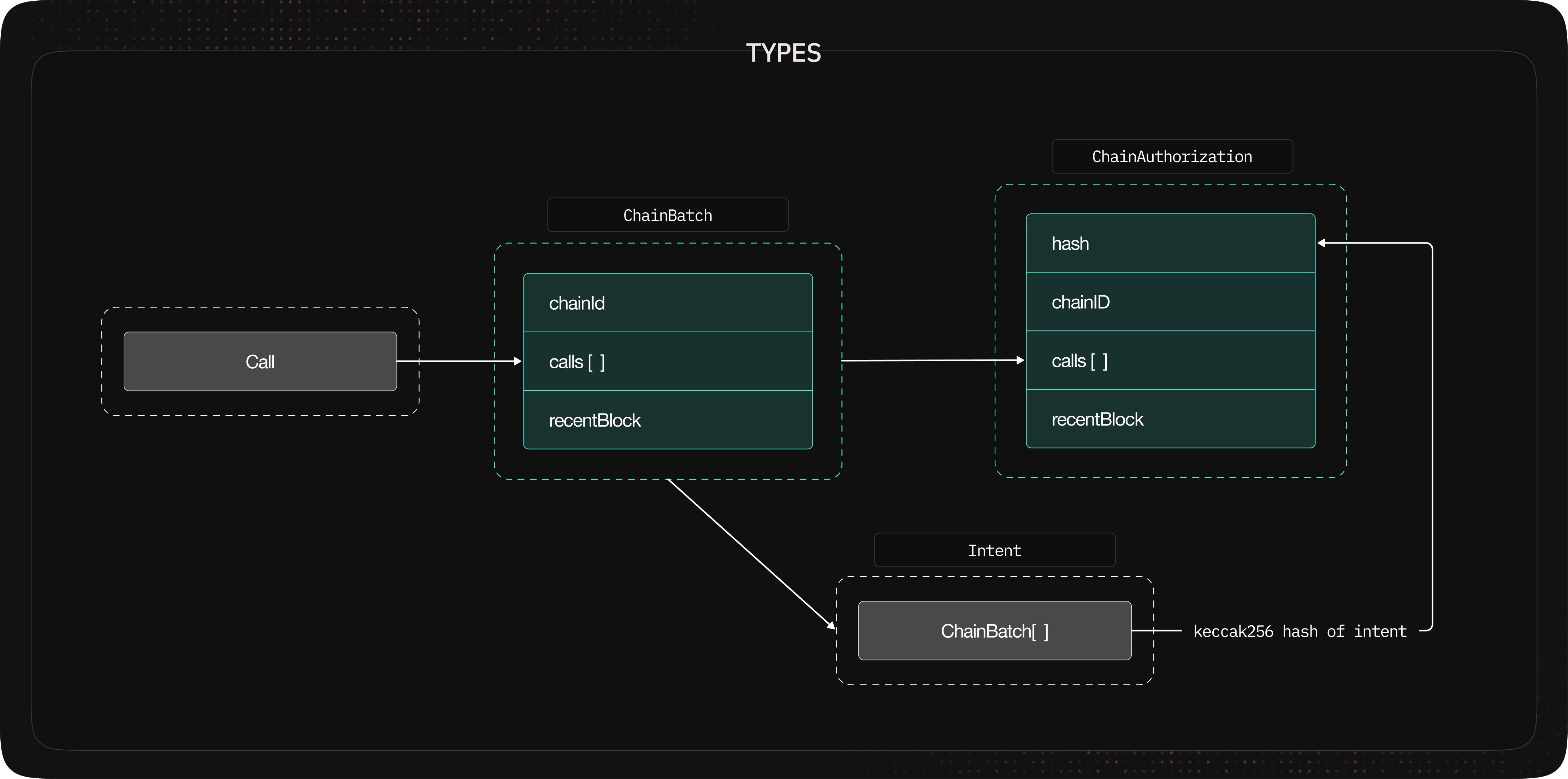
The API uses the following naming convention:
* **Intent**: The parent action which contains ChainBatch(es)
* **ChainBatch**: For a specific chain, and has many Call(s)
* **Call**: Has `to`, `data`, and `value` parameters
 ## Process Flow
 For a detailed technical explanation of the underlying technologies, including EIP-7702 and the `Delegate` contract, see our deep dive on [EIP-7702](/deep-dive/eip7702) and [Delegate Contract](/deep-dive/delegate).
## What Actually Happens
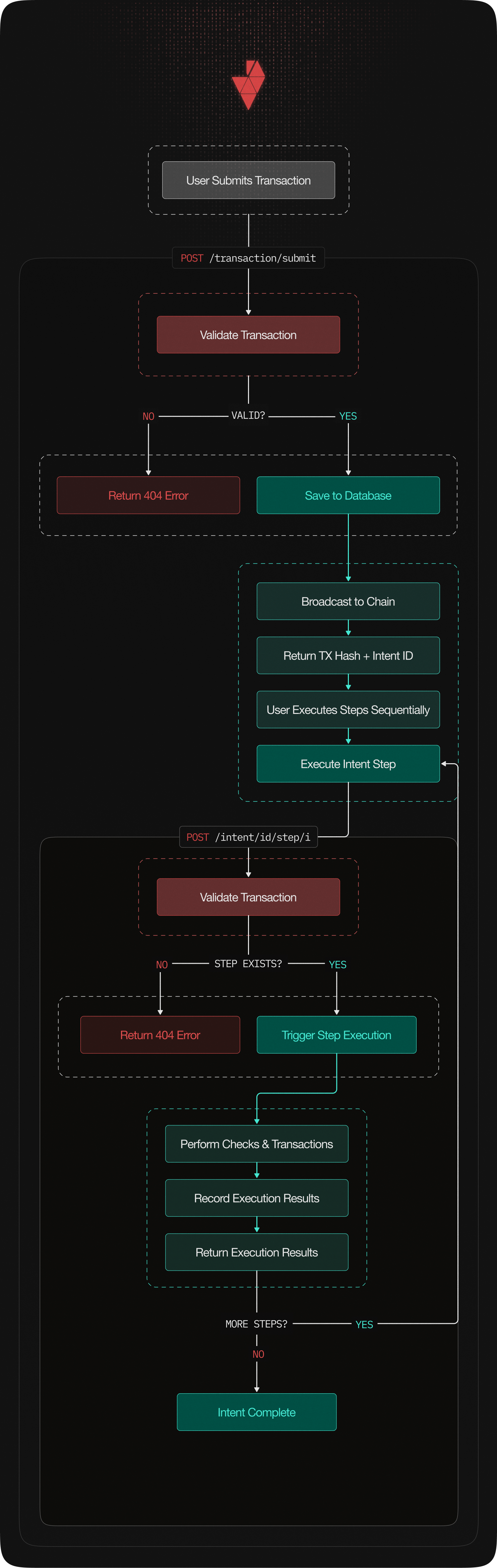
### 1. Transaction Submission
When you call `POST /transaction/submit`:
1. **Transaction Validation**: API validates the transaction structure and authorization array
2. **Database Storage**: Intent and authorization data is saved to the database
3. **Chain Broadcast**: Transaction is broadcast to the appropriate blockchain
4. **Response**: Returns transaction hash and intent ID for tracking
### 2. Intent Execution
When you call `POST /intent/{intentId}/execute/{stepId}`:
1. **Step Lookup**: Retrieves the specific step from the database using intent ID and step index
2. **Execution Trigger**: Performs the actual work for that step (checks, transactions, etc.)
3. **Result Capture**: Records execution results and any transaction hashes
4. **Response**: Returns execution status and results
## Technical Implementation
### Intent Structure
```typescript theme={null}
interface Intent {
intentId: string; // Signature of chainBatches
chainBatches: ChainBatch[];
status: "created" | "executing" | "success" | "error" | "reverted";
steps: IntentStep[];
}
```
### Step Execution Model
```typescript theme={null}
interface IntentStep {
stepId: number; // Index [0, n) in chainBatches array
chainId: number; // Target chain for this step
status: "created" | "executing" | "success" | "error" | "reverted";
transactionHash?: string; // Hash if transaction was sent
executionResult?: object; // Results of step execution
}
```
### Transaction Submit Request Structure
```typescript theme={null}
interface TransactionSubmitRequest {
authorization: [
{
chainId: number;
address: string;
nonce: number;
r: string; // ECDSA signature R value
s: string; // ECDSA signature S value
yParity: number; // ECDSA signature Y parity
},
];
intentAuthorization: {
signature: string; // This becomes the intent ID
chainBatches: ChainBatch[];
};
}
```
## Key Concepts
### Intent ID Generation
* The intent ID is the **signature of the chainBatches**
* This approach is similar to Solana's transaction ID system
* Provides a unique, deterministic identifier for each intent
### Step Index System
* Steps are indexed as integers: `[0, n)` where n = chainBatches.length
* Step 0 = first chain authorization, Step 1 = second, etc.
* Steps must be executed sequentially in order
### Authorization Array
* **Multiple Authorizations**: Can submit multiple EIP-7702 authorizations in a single transaction
* **Cross-Chain Support**: Each authorization can be for different chains or addresses
* **Flexible Delegation**: Supports complex multi-chain execution patterns
### Execution Model
* **Active Execution**: Calling the POST endpoint triggers actual work
* **Unit of Work**: Each step call performs one discrete operation
* **Stateful**: Execution state is persisted in the database
* **Resumable**: Failed or interrupted intents can be resumed
## Error Handling
The API implements comprehensive error handling:
* **400 Bad Request**: Invalid transaction format, malformed parameters, or out-of-range step IDs
* **404 Not Found**: Intent not found or step index exceeds available steps
* **500 Internal Server Error**: Database errors, chain communication failures, or execution errors
```typescript theme={null}
// Example error response
{
"success": false,
"error": {
"message": "Step execution failed: insufficient gas"
}
}
```
## Data Persistence
Unlike the current in-memory implementation:
* **Database Storage**: All intent data is persisted to database
* **Reliable Execution**: Steps can be retried if they fail
* **Audit Trail**: Complete execution history is maintained
* **Recovery**: System can recover from restarts without losing state
## Monitoring
Comprehensive monitoring capabilities:
* **Database Logging**: All operations are logged to database
* **Execution Tracking**: Detailed step-by-step execution results
* **Transaction Hashes**: All on-chain transactions are tracked
* **Status Endpoints**: Real-time status via API calls
## Use Cases
### Perp DEXes
Power bridge-free native deposits from every network into margin accounts on Perp DEXes.
### Money Markets
Enable users to natively deposit assets directly into lending markets from every major network.
### AMMs
Facilitate bridge-free provision of liquidity from every network by enabling users to deposit assets into liquidity pools from any chain.
For a detailed technical explanation of the underlying technologies, including EIP-7702 and the `Delegate` contract, see our deep dive on [EIP-7702](/deep-dive/eip7702) and [Delegate Contract](/deep-dive/delegate).
## What Actually Happens
### 1. Transaction Submission
When you call `POST /transaction/submit`:
1. **Transaction Validation**: API validates the transaction structure and authorization array
2. **Database Storage**: Intent and authorization data is saved to the database
3. **Chain Broadcast**: Transaction is broadcast to the appropriate blockchain
4. **Response**: Returns transaction hash and intent ID for tracking
### 2. Intent Execution
When you call `POST /intent/{intentId}/execute/{stepId}`:
1. **Step Lookup**: Retrieves the specific step from the database using intent ID and step index
2. **Execution Trigger**: Performs the actual work for that step (checks, transactions, etc.)
3. **Result Capture**: Records execution results and any transaction hashes
4. **Response**: Returns execution status and results
## Technical Implementation
### Intent Structure
```typescript theme={null}
interface Intent {
intentId: string; // Signature of chainBatches
chainBatches: ChainBatch[];
status: "created" | "executing" | "success" | "error" | "reverted";
steps: IntentStep[];
}
```
### Step Execution Model
```typescript theme={null}
interface IntentStep {
stepId: number; // Index [0, n) in chainBatches array
chainId: number; // Target chain for this step
status: "created" | "executing" | "success" | "error" | "reverted";
transactionHash?: string; // Hash if transaction was sent
executionResult?: object; // Results of step execution
}
```
### Transaction Submit Request Structure
```typescript theme={null}
interface TransactionSubmitRequest {
authorization: [
{
chainId: number;
address: string;
nonce: number;
r: string; // ECDSA signature R value
s: string; // ECDSA signature S value
yParity: number; // ECDSA signature Y parity
},
];
intentAuthorization: {
signature: string; // This becomes the intent ID
chainBatches: ChainBatch[];
};
}
```
## Key Concepts
### Intent ID Generation
* The intent ID is the **signature of the chainBatches**
* This approach is similar to Solana's transaction ID system
* Provides a unique, deterministic identifier for each intent
### Step Index System
* Steps are indexed as integers: `[0, n)` where n = chainBatches.length
* Step 0 = first chain authorization, Step 1 = second, etc.
* Steps must be executed sequentially in order
### Authorization Array
* **Multiple Authorizations**: Can submit multiple EIP-7702 authorizations in a single transaction
* **Cross-Chain Support**: Each authorization can be for different chains or addresses
* **Flexible Delegation**: Supports complex multi-chain execution patterns
### Execution Model
* **Active Execution**: Calling the POST endpoint triggers actual work
* **Unit of Work**: Each step call performs one discrete operation
* **Stateful**: Execution state is persisted in the database
* **Resumable**: Failed or interrupted intents can be resumed
## Error Handling
The API implements comprehensive error handling:
* **400 Bad Request**: Invalid transaction format, malformed parameters, or out-of-range step IDs
* **404 Not Found**: Intent not found or step index exceeds available steps
* **500 Internal Server Error**: Database errors, chain communication failures, or execution errors
```typescript theme={null}
// Example error response
{
"success": false,
"error": {
"message": "Step execution failed: insufficient gas"
}
}
```
## Data Persistence
Unlike the current in-memory implementation:
* **Database Storage**: All intent data is persisted to database
* **Reliable Execution**: Steps can be retried if they fail
* **Audit Trail**: Complete execution history is maintained
* **Recovery**: System can recover from restarts without losing state
## Monitoring
Comprehensive monitoring capabilities:
* **Database Logging**: All operations are logged to database
* **Execution Tracking**: Detailed step-by-step execution results
* **Transaction Hashes**: All on-chain transactions are tracked
* **Status Endpoints**: Real-time status via API calls
## Use Cases
### Perp DEXes
Power bridge-free native deposits from every network into margin accounts on Perp DEXes.
### Money Markets
Enable users to natively deposit assets directly into lending markets from every major network.
### AMMs
Facilitate bridge-free provision of liquidity from every network by enabling users to deposit assets into liquidity pools from any chain.